
Cover girl tips

In this post, I’ll share two cover letters I’ve written to illustrate my thinking and approach.
The first letter is one I wrote in December 2015 to Columbia Engineering to work as the coordinator for the career placement team.
I knew I needed to get the reviewer’s attention and slow them down. I tried doing that by opening in an unconventional way and keeping it short (my letter was half a page).
Even though the job description was robust, I knew a cover letter wasn’t the stage to address everything. I decided to focus on a couple of things that seemed important and I could speak to well.
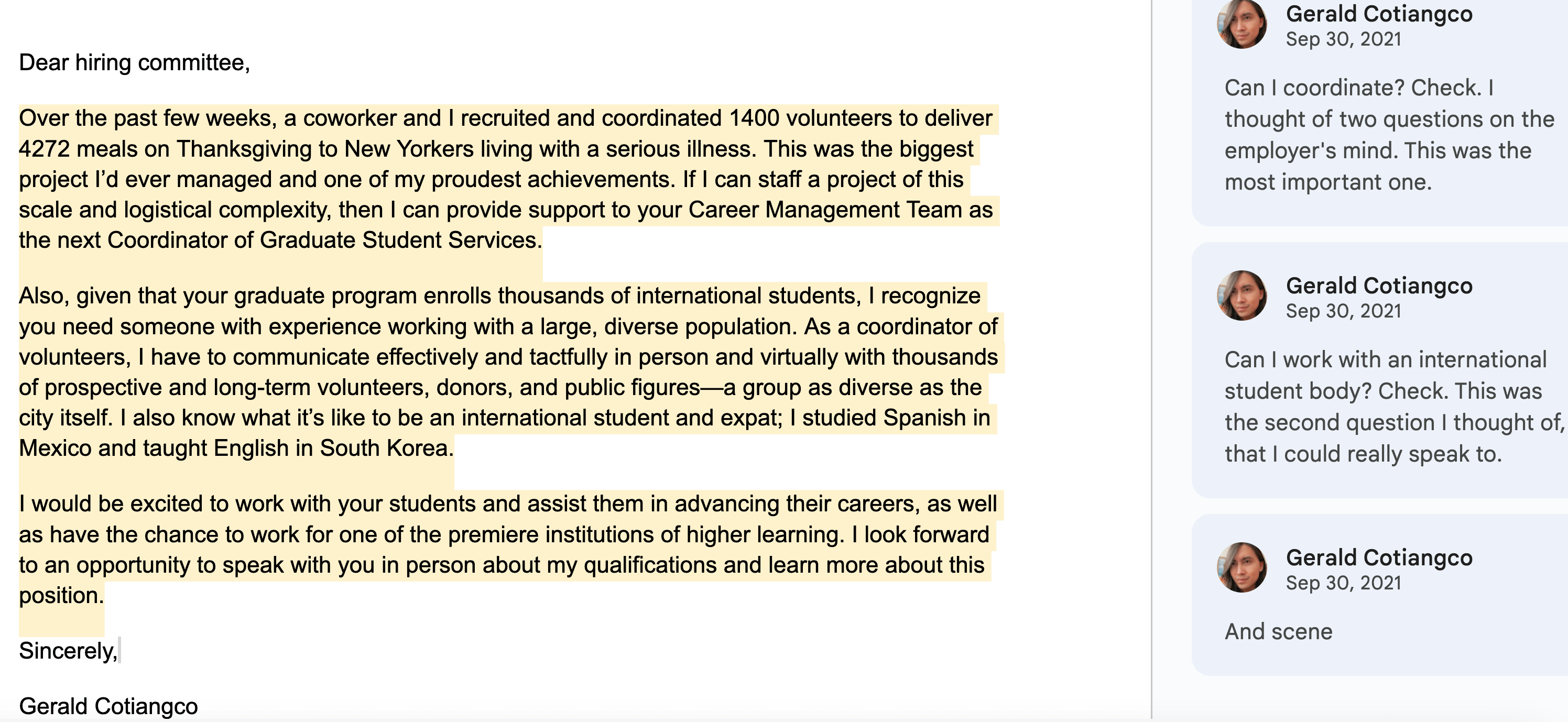
As you can see, I open with an example of my coordinating abilities. It's attention grabbing because (1) it's not the typical I am applying for X role and my experience in X Y Z makes me a great candidate and (2) I'm addressing head on an essential question the employer has (in this case, can you coordinate?)
I get right to the point—yes I can, and here's my best example in one sentence, which is both concise yet contains enough details for my reader to understand the scale, scope, and significance of my achievement, and gives them a sense of what I know and can do.
I could've given the hiring committee a litany of coordinating examples, but there’s no time for that. I need my best example (or two) to be enough. The lift of the cover letter is to compel the reviewer to slow down and really take in your application.
For my second paragraph, I open in a more conventional way (the opening sentence frames what the paragraph is about). But, like in my first paragraph, I address what I believe to be a top-of-mind question/need (ie, can you work with an international student body?) I provide two concrete examples as evidence that I can. Each example is just one sentence, which is to say: you can be detailed without being wordy.
Then I use my third paragraph to close.
In my second cover letter, to Columbia Climate School, I do a few things differently. I still address essential questions, but I expend more effort differentiating myself from the competition.
This job is to start, grow, and lead the Climate School’s career office. (Don’t mind my sassy comments on the side 😊)
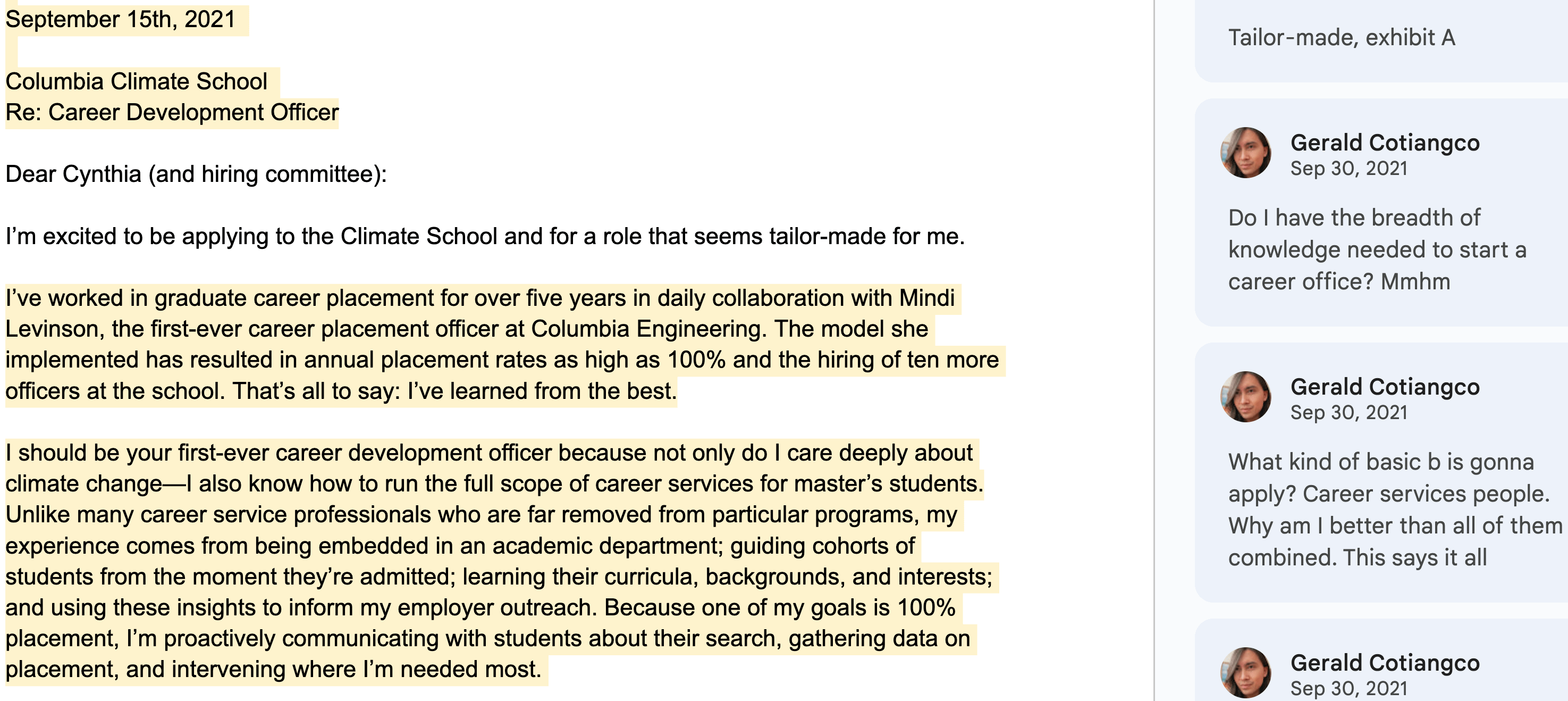
In my first real paragraph, I front-load what I think makes me a highly unique and compelling candidate:
I’ve worked in graduate career placement for over five years in daily collaboration with Mindi Levinson, the first-ever career placement officer at Columbia Engineering. The model she implemented has resulted in annual placement rates as high as 100% and the hiring of ten more officers at the school. That’s all to say: I’ve learned from the best.
In that first sentence, I concisely include the following elements: I've worked specifically with master's students, for five years, at Columbia, and for the first-ever career placement officer.
If the reviewer doesn't read anything more, I'm fine with that. I didn't waste time in getting to the good stuff
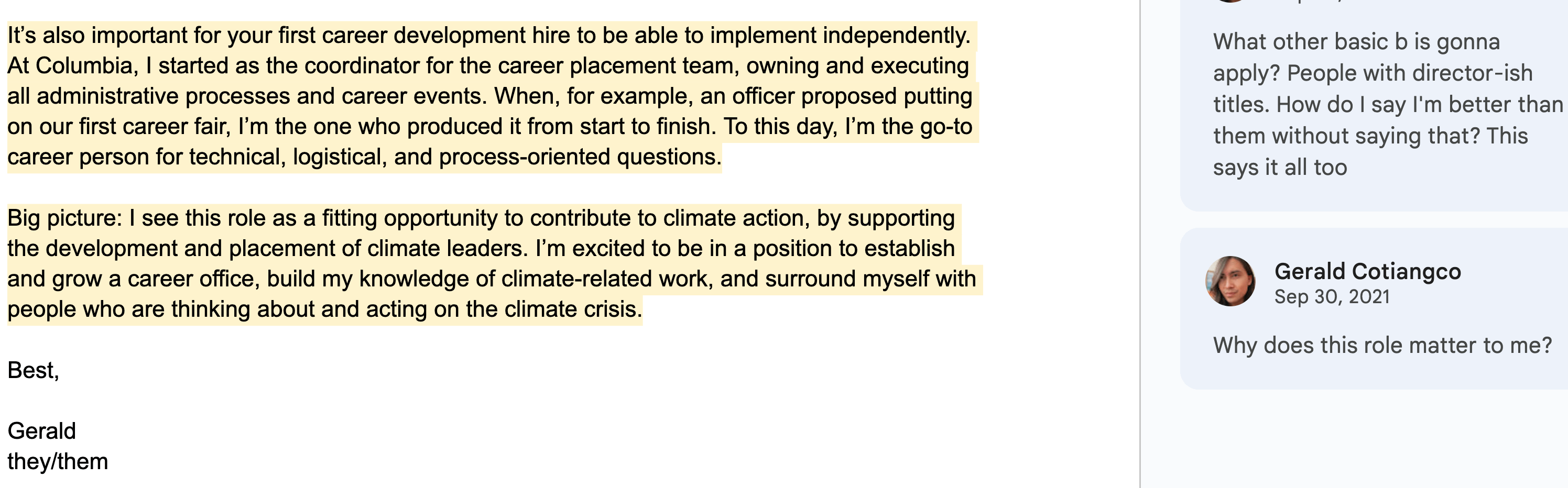
I also differentiate myself from career services people with director titles by asserting my point of view that the hiring team needs X, which I have. In this case, the Climate Schools needs their first career officer to implement everything independently, which I can, given my background.
I end with what this opportunity means to me (ie, why I'd be so motivated to do this work). I literally write "Big picture: . . . " I recommend talking about your motivations only after you’ve established that you can do the job. First things first!
These are just a few ways to think about and approach cover letter writing.
Most cover letters are just resumes in disguise or generic bios, and when people detect that, they tend to skip the letter entirely, so think about how to use the cover letter to help you stand out!